
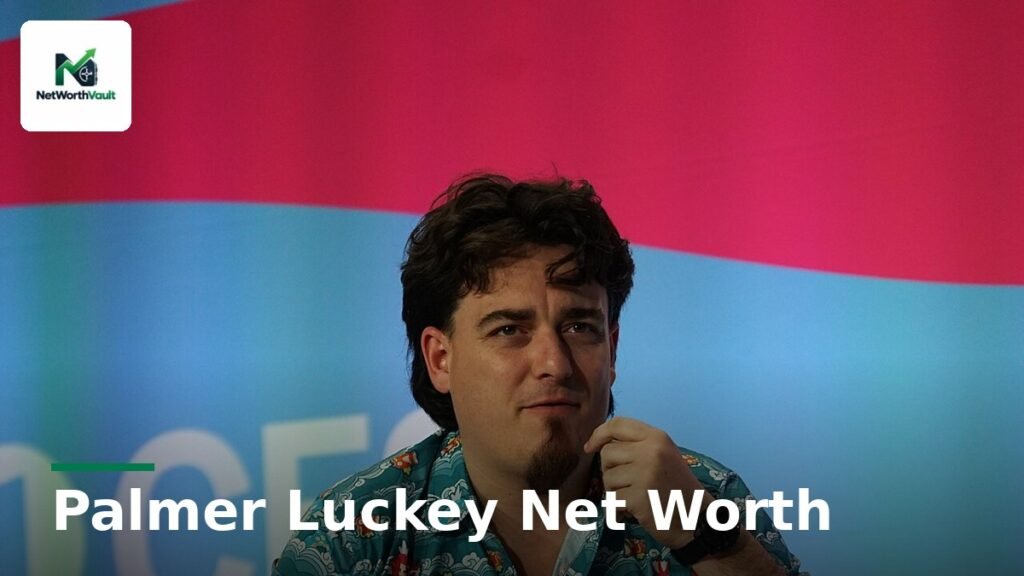
Palmer Luckey Net Worth is one of the fastest-moving fortunes in American business. How does a 34-year-old who built his first virtual reality headset in his parents’ garage end up worth nearly $6 billion? The answer, according to Forbes, is an estimated net worth of $5.9 billion.
Forbes published that figure on September 4, 2026, when Luckey debuted on the Forbes 400 at No. 287. Almost all of it comes from his stake in Anduril Industries, the defense technology company he co-founded in 2017, which investors valued at $61 billion in May 2026. Before Anduril, he founded Oculus VR and sold it to Facebook for about $2 billion in 2014 — and this is the story of how he did it twice.
In This Article
- Who Is Palmer Luckey?
- Palmer Luckey Net Worth in 2026: The $5.9 Billion Estimate Explained
- How We Calculate Net Worth
- Early Life: A Homeschooled Tinkerer in Long Beach
- Building the Oculus Rift in a Garage
- The Kickstarter That Revived Virtual Reality
- The $2 Billion Facebook Sale
- The Fall From Facebook: Controversy and Departure
- Anduril Industries: Building a Defense Tech Giant
- How Does Palmer Luckey Make Money?
- The ZeniMax Lawsuit
- Other Ventures: ModRetro and Investments
- Personal Life: Marriage to Nicole Edelmann
- Net Worth Growth Over the Years
- Final Thoughts
Quick Facts
| Detail | Information |
|---|---|
| Full Name | Palmer Freeman Luckey |
| Date of Birth | September 19, 1992 |
| Age | 34 as of November 2026 |
| Birthplace | Long Beach, California, USA |
| Nationality | American |
| Occupation | Entrepreneur, inventor, defense technology founder |
| Education | California State University, Long Beach (withdrew) |
| Years Active | 2012–present |
| Companies | Oculus VR (founder, 2012); Anduril Industries (co-founder, 2017); ModRetro (founder) |
| Best Known For | Creating the Oculus Rift; co-founding Anduril Industries |
| Estimated Net Worth | $5.9 billion (Forbes 400, September 4, 2026) |
| Main Income Sources | Equity stake in Anduril Industries; proceeds from the Oculus sale to Facebook |
| Spouse | Nicole Edelmann (married 2019) |
| Forbes 400 Rank | No. 287 (2026) |
Who Is Palmer Luckey?
Palmer Luckey is an American entrepreneur and the co-founder of defense technology company Anduril Industries. Before that, he was the founder of Oculus VR and the designer of the Oculus Rift, the virtual reality headset widely credited with reviving the virtual reality industry.
Luckey’s career has followed an unusual path. He was homeschooled in Long Beach, California, taught himself electronics, and began building VR headsets in his teens because the ones on the market were too expensive and too poor in quality. At 19, he built a working prototype in his parents’ garage. At 21, he sold the company to Facebook for about $2 billion. At 24, he was fired from Facebook after a political controversy. And at 25, he started over in defense technology — an industry most Silicon Valley founders avoid — and built a company now valued at $61 billion.
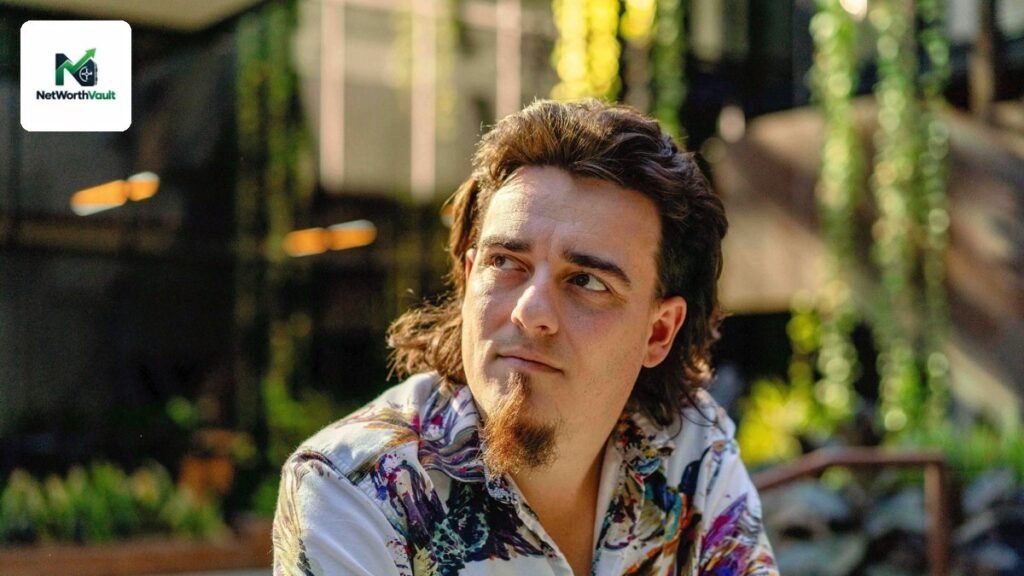
He is known for his Hawaiian shirts, his mullet, and his outspoken views, but the numbers are what matter most. Forbes lists him as self-made, and at 34, he is one of the youngest billionaires in America.
Palmer Luckey Net Worth in 2026: The $5.9 Billion Estimate Explained
As of 2026, Palmer Luckey’s net worth is estimated at $5.9 billion, according to Forbes, which published the figure on September 4, 2026, for its Forbes 400 list of the richest Americans, where he debuted at No. 287 as the list’s second-youngest member. Forbes’ real-time tracker put him at about $6 billion in October 2026, and Celebrity Net Worth also gives about $6 billion. That is the figure we use as our headline estimate, because Forbes is the most authoritative source for his wealth.
Other estimates tell the same story with different dates. Forbes valued him at $3.5 billion in February 2026, and at about $5 billion in May 2026, when Anduril closed its Series H funding round. The honest way to describe it is this: most credible estimates place Palmer Luckey’s net worth between $5 billion and $6 billion in late 2026, with $5.9 billion — the Forbes 400 figure — as the most widely cited point in that range.
Why the spread, and why does the number move so fast? Almost all of Luckey’s wealth is held as private shares in Anduril, a company that is not listed on a stock exchange. When Anduril’s valuation jumps, his paper fortune jumps with it, even though he has not sold his shares or received that money in cash. Anduril was valued at $14 billion in August 2024, at $30.5 billion in June 2025, and at $61 billion in May 2026 — roughly doubling each time. His net worth followed the same path.
The most important distinction is between a paper fortune and cash. The $61 billion is Anduril’s value, not Luckey’s wealth, and the roughly $2 billion Facebook paid for Oculus was the deal value for the whole company, not his personal payout. His exact stake in Anduril is not publicly disclosed, and it has been diluted by funding rounds that have raised more than $7.8 billion in total. Forbes’ estimate is its best judgment of what his stake is worth at the latest funding-round price — not a bank balance.
How We Calculate Net Worth
At Net Worth Vault, we calculate net worth by adding up the income we can verify from public sources, estimating the value of known businesses and assets, and then subtracting typical taxes, fees, and living costs. For Palmer Luckey, that calculation is dominated by one asset: his equity in Anduril Industries.
Anduril’s most recent funding round, a $5 billion Series H announced on May 13, 2026, and led by Thrive Capital and Andreessen Horowitz, valued the company at $61 billion. Analysts estimate Luckey’s ownership at somewhere between 5 and 15 percent of the company, based on founder equity at formation and the dilution from later rounds. At a $61 billion valuation, a 5 percent stake would be worth about $3 billion, and a 10 percent stake would be worth about $6 billion — a range that maps almost exactly onto the spread between Forbes’ estimates.
We also count the Oculus sale. Facebook acquired Oculus VR in March 2014 for about $2 billion in cash and stock, and Forbes estimated Luckey’s net worth at about $700 million in 2015, based on his equity at the time of the sale. His personal share of the proceeds was never made public, so we do not state it as a fact.
There are real limits to what we can verify. His exact Anduril stake is not disclosed, and neither are his salary or any secondary share sales. We do not invent those numbers. What we can say with confidence is that the Forbes estimate is built on a real, dated funding-round valuation for a real company with reported revenue of about $1 billion in 2024 — which makes it far more solid than most celebrity net worth figures.
Early Life: A Homeschooled Tinkerer in Long Beach
Palmer Freeman Luckey was born on September 19, 1992, in Long Beach, California, to Donald Luckey, a car salesman, and Julie Freeman Luckey. He grew up with three younger sisters in a homeschooled household, and from an early age he was obsessed with taking things apart and building new ones.
As a teenager, he collected old virtual reality headsets — the bulky, expensive devices made for military and research use — and studied why they failed. They were heavy, low-resolution, narrow in their field of view, and they cost tens of thousands of dollars. He became convinced he could build something better and cheaper using off-the-shelf smartphone parts: small, high-resolution screens, motion sensors, and cheap optics.
He enrolled at California State University, Long Beach, but he did not finish. In 2009, when he was 16, he began building virtual reality headsets of his own design in his parents’ garage and camper trailer. By 2012, he had a working prototype that would change the technology industry.
Building the Oculus Rift in a Garage
The prototype that became the Oculus Rift was built from parts Luckey bought and modified himself. He used a smartphone display, lenses, and motion-tracking sensors, and he wrote the software to make them work together. The result was a headset with a wide field of view and low latency — the two things that make virtual reality feel real instead of making the wearer feel sick.
He showed the prototype to people in the games industry, and the reaction was immediate. John Carmack, the legendary programmer behind Doom, demonstrated his game Doom 3: BFG Edition running on Luckey’s prototype at the E3 trade show in June 2012, and the gaming world took notice. Gabe Newell, the president of Valve, endorsed the project publicly.
Luckey turned down a $70,000 job offer from Sony to keep working on the Rift. It was a gamble, but it was the kind of gamble that defines a founder’s life: a steady job at a big company, or an uncertain project in a garage. He chose the garage, and he has been building companies ever since.
The Kickstarter That Revived Virtual Reality
In April 2012, Luckey founded Oculus VR to launch a Kickstarter campaign for the Oculus Rift. The campaign, which went live in August 2012, asked for $250,000. It raised more than $2.4 million from nearly 10,000 backers — 974 percent of its original target — and it carried recorded endorsements from major figures in the games industry, including Cliff Bleszinski and Michael Abrash.
The campaign did more than raise money. It proved that ordinary people wanted virtual reality, and it revived an industry that most technology companies had written off. After raising more than $1 million, Luckey hired Brendan Iribe in August 2012 to be Oculus VR’s CEO, and he brought on co-founders Nate Mitchell, Michael Antonov, and Andrew Scott Reisse.
Within two years, Oculus VR went from a garage project to one of the most talked-about startups in Silicon Valley. The Kickstarter backers got their developer kits, the press got its story, and Facebook got interested — which is where the money really started.
The $2 Billion Facebook Sale
In March 2014, Facebook — which later became Meta Platforms — acquired Oculus VR for about $2 billion in cash and stock. Luckey was 21 years old. The deal made him one of the technology industry’s youngest billionaires on paper, and it put virtual reality at the center of Facebook’s plans for the future.
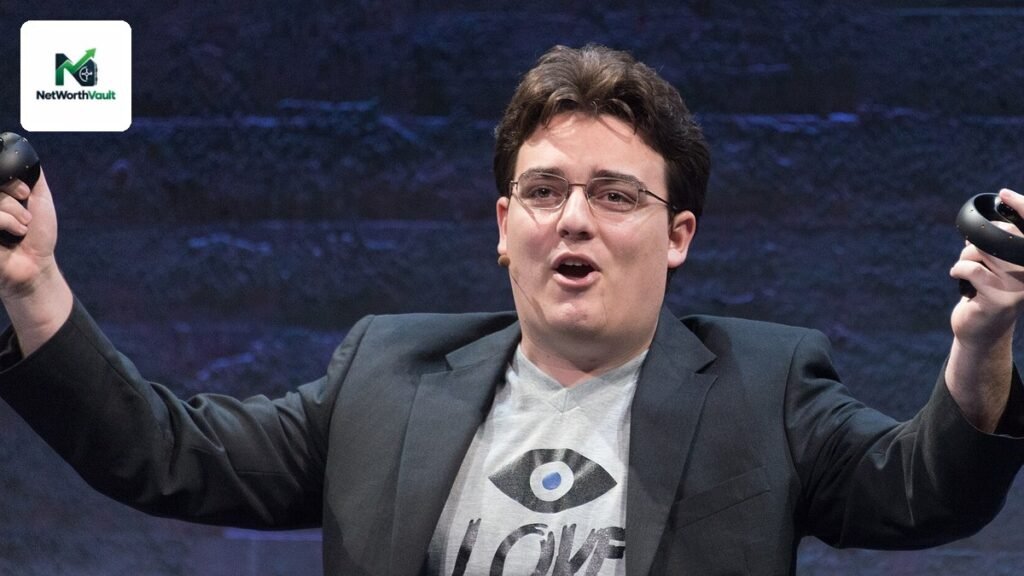
Luckey joined Facebook as an employee and continued working on VR hardware, including the Oculus Touch motion controllers. The acquisition was one of the most celebrated technology deals of the decade, and it seemed to confirm that the garage prototype had been worth the gamble.
But the sale came with a cost that is easy to miss. Luckey’s personal share of the $2 billion was never made public, and Forbes estimated his net worth at only about $700 million in 2015 — a reminder that a company’s sale price is not its founder’s payout. Taxes, other shareholders, and the mix of cash and stock all reduce what any single founder takes home. The same care applies to other founders we profile, and Steve Huffman’s net worth shows a similar pattern: a founder’s paper wealth depends on how much of the company he still owns when the big deal happens.
The Fall From Facebook: Controversy and Departure
Luckey’s time at Facebook ended amid political controversy. In September 2016, news organizations reported that he had donated $10,000 to Nimble America, a pro-Donald Trump political organization that promoted online political memes and sponsored an anti-Hillary Clinton billboard. The revelation sparked significant media controversy and internal backlash among Facebook employees.
Luckey was sidelined within Facebook, removed from public appearances, and effectively frozen out of Oculus decision-making. In March 2017, Facebook dismissed him. Luckey has said he was fired because of his political activity, while Facebook provided no public reason for his dismissal. When Senator Ted Cruz later asked Mark Zuckerberg directly in Senate testimony in April 2018 why Luckey had been fired, Zuckerberg declined to explain, saying it was not due to his political views. In November 2018, the Wall Street Journal reported on internal Facebook emails suggesting that executives had pressured Luckey to publicly support the Libertarian candidate Gary Johnson.
After his departure, Luckey negotiated a payout, arguing that Facebook had violated California law. The episode left him wealthy but unwelcome in the part of Silicon Valley he had helped to build. It also left him free to start again — and this time, he chose an industry that Silicon Valley had largely abandoned.
Anduril Industries: Building a Defense Tech Giant
In June 2017, Luckey co-founded Anduril Industries with Trae Stephens, Brian Schimpf, Matt Grimm, and Joseph Chen. The company is named after Andúril, the sword from J.R.R. Tolkien’s The Lord of the Rings, and it set out to modernize the defense capabilities of the United States and its allies by building military systems with artificial intelligence and a faster approach to developing new technology.
Anduril’s pitch was simple: the big defense contractors were slow, expensive, and built hardware first. Anduril would build software first — an AI platform called Lattice that connects sensors, drones, and other systems — and develop its products with its own money, then sell them to the military. It was the Silicon Valley playbook applied to an industry that had never used it.
The approach worked. Anduril won contracts with the US Department of Defense and its allies, built autonomous drones and surveillance systems, and grew its revenue to about $1 billion in 2024, doubling year over year. Its valuation climbed with it: $14 billion in August 2024, $30.5 billion in June 2025, and $61 billion in May 2026, when it raised $5 billion in a Series H round led by Thrive Capital and Andreessen Horowitz.
Anduril’s products show how the software-first idea works in practice. Its Lattice platform ties together sensors, drones, and other systems so they can share what they see in real time, and its hardware ranges from autonomous aircraft to surveillance towers used on the US southern border. In February 2025, Anduril also took over the Army’s IVAS augmented-reality headset program from Microsoft, bringing Luckey’s career full circle — back to the headset technology where he started. Defense technology is not a subject most net worth profiles cover, and the reporting of Trey Yingst’s net worth offers a useful contrast — a journalist who covers the conflicts where Anduril’s systems are used, rather than the company that builds them.
How Does Palmer Luckey Make Money?
Palmer Luckey makes money almost entirely from equity in the companies he founded, and today that means Anduril Industries. He does not draw a large public salary, and he does not have the endorsement deals or speaking fees that fill out many celebrity fortunes. His wealth is his stake in a private company, and it rises and falls with Anduril’s valuation.
The second source of his wealth is the Oculus sale. Facebook’s $2 billion acquisition in 2014 gave him cash and stock, and Forbes estimated him at about $700 million in 2015 on the strength of it. That money was the foundation for everything that followed, including the seed funding for Anduril.
The third source is smaller but real: his other ventures and investments. He founded ModRetro, a company that makes retro gaming hardware including the Chromatic handheld, and he has invested in other technology startups. But these are minor next to Anduril, which accounts for the overwhelming majority of his estimated $5.9 billion.
The key point is that Luckey’s fortune is not income — it is ownership. He got rich by founding companies and keeping a large stake in them, not by earning a salary. That is why his net worth can jump by billions of dollars in a single year without him selling anything at all.
The ZeniMax Lawsuit
Shortly after the Facebook acquisition, ZeniMax Media filed a lawsuit claiming that Luckey and Oculus had used its technology and trade secrets. The case went to trial in early 2017, and on February 2, 2017, a jury found that Luckey had violated a non-disclosure agreement he had with ZeniMax, but awarded zero damages on that charge, judging the harm to be minimal.
The jury also found that Oculus, Facebook, Luckey, and others had not misappropriated or stolen trade secrets, but it awarded a combined total of $500 million in damages for copyright infringement related to the marketing of the Oculus Rift, with Luckey personally responsible for $50 million of the total. In June 2018, the judge overseeing the case reduced the award, affirming about $200 million in total damages.
The lawsuit is a reminder that even a $2 billion acquisition comes with legal risk. For Luckey, the $50 million personal judgment was a small fraction of his fortune, and it did not slow him down. Within months of the verdict, he had already co-founded Anduril and moved on to his next company.
Other Ventures: ModRetro and Investments
Beyond Oculus and Anduril, Luckey founded ModRetro, a company that builds modern versions of classic gaming hardware. Its best-known product is the Chromatic, a handheld console that plays original Game Boy cartridges on a modern screen, with a magnesium alloy body and a bright display that the original hardware never had. It is a niche business, built out of Luckey’s personal love of retro gaming, and it shows the same instinct that drove the Oculus Rift: take old hardware, rebuild it better, and sell it to people who care.
He has also invested in other technology companies, though he keeps a lower profile as an investor than many of his peers. Unlike some founders who become full-time venture capitalists after a big exit, Luckey has stayed focused on building Anduril, where he remains the public face of the company and its most recognizable founder.
Personal Life: Marriage to Nicole Edelmann
Palmer Luckey married Nicole Edelmann, his long-time girlfriend and a professional gamer, in 2019. The couple keeps a low profile, and little is publicly known about their personal life beyond the marriage itself. Edelmann is known in gaming circles, but the pair rarely appear in public together or discuss their relationship in interviews.
Luckey is known for his distinctive personal style — Hawaiian shirts, shorts, and a mullet — and for his outspoken political views, which have made him a controversial figure in Silicon Valley. He is also known for his interest in military history, retro video games, and Tolkien, whose work gave Anduril its name. He lives in California, where Anduril is headquartered in Costa Mesa, and he remains deeply involved in the company’s day-to-day work.
Net Worth Growth Over the Years
Palmer Luckey’s fortune has grown in sharp steps, and each step followed a funding round at Anduril. In 2015, after the Oculus sale, Forbes estimated him at about $700 million. By February 2026, the estimate had risen to $3.5 billion. In May 2026, when Anduril closed its $5 billion Series H at a $61 billion valuation, Forbes put him at about $5 billion. By September 4, 2026, the Forbes 400 listed him at $5.9 billion, and by October 2026, the real-time tracker showed about $6 billion.
Each jump followed the same pattern: Anduril raised money at a higher price, and Luckey’s stake became worth more on paper. His wealth has grown roughly eightfold since the Oculus sale, and almost all of that growth has come from Anduril alone. The lesson is the same one that runs through every great founder fortune: own a large piece of a company that keeps getting more valuable. It is the same principle that Morgan Housel’s net worth profile describes from the investor’s side — wealth compounds when you hold a growing asset for a long time and let it work.
Final Thoughts
Palmer Luckey’s net worth of $5.9 billion is the fortune of a founder who did the hardest thing in business twice: he built a company that changed an industry, sold it, and then built another one. From a garage prototype in Long Beach to a $61 billion defense company, his career shows that the biggest fortunes come from ownership, not salary.
The figure is an estimate, built on a private company’s funding-round price and an undisclosed stake, so it will keep moving as Anduril raises money or wins contracts.
For more on founders who built wealth the same way, Logan Paul’s net worth shows a creator who turned an audience into a business empire of his own.
Frequently Asked Questions
What is Palmer Luckey’s net worth in 2026?
Palmer Luckey’s net worth is estimated at $5.9 billion in 2026, according to Forbes, which published the figure on September 4, 2026, for its Forbes 400 list, where he debuted at No. 287. Almost all of it comes from his stake in Anduril Industries, valued at $61 billion in May 2026.
How did Palmer Luckey make his money?
Luckey made his money by founding companies and keeping a large stake in them. He founded Oculus VR, which Facebook bought for about $2 billion in 2014, and then co-founded Anduril Industries in 2017. His Anduril stake, valued at the company’s $61 billion funding-round price, accounts for nearly all of his fortune.
How much is Anduril worth?
Anduril Industries was valued at $61 billion in May 2026, when it raised $5 billion in a Series H round led by Thrive Capital and Andreessen Horowitz. That was roughly double its $30.5 billion valuation from June 2025, which was itself more than double its $14 billion valuation from August 2024.
Why was Palmer Luckey fired from Facebook?
Facebook dismissed Luckey in March 2017 after a controversy over his $10,000 donation to Nimble America, a pro-Trump political organization. Luckey has said he was fired because of his political activity, while Facebook gave no public reason. Mark Zuckerberg declined to explain the dismissal in Senate testimony in April 2018.
Who is Palmer Luckey’s wife?
Palmer Luckey married Nicole Edelmann, his long-time girlfriend and a professional gamer, in 2019. The couple keeps a low profile, and little is publicly known about their personal life beyond the marriage. Edelmann is known in gaming circles, but the pair rarely appear in public together or discuss their relationship in interviews.