
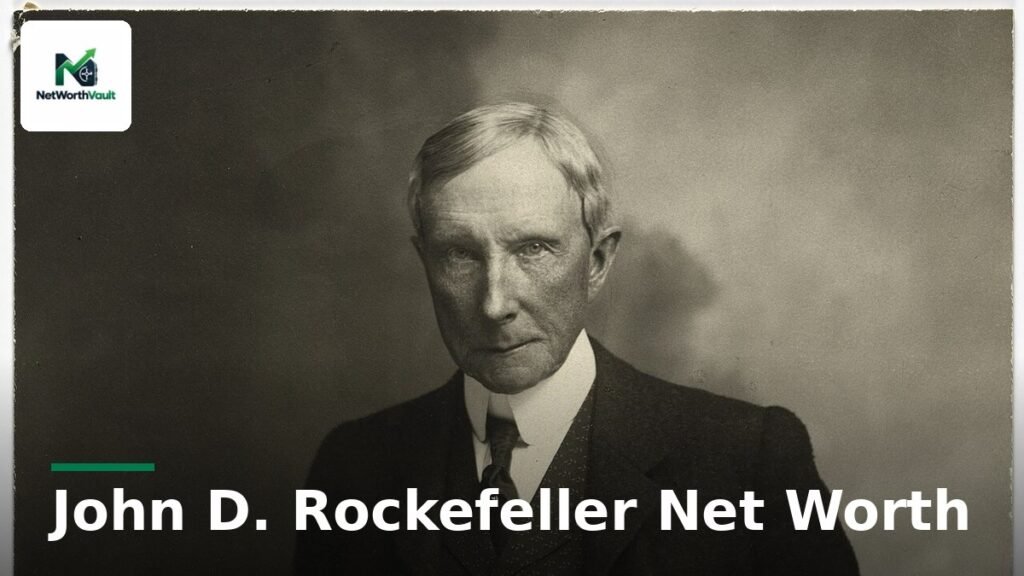
John D. Rockefeller did not just get rich. He got so rich that, more than eighty years after his death, economists still argue about how to measure his fortune — because no single number really captures it.
When Rockefeller died in 1937, his remaining fortune was estimated at $1.4 billion. That sounds almost modest next to today’s tech billionaires, until you put it in context. In 1937, that $1.4 billion was roughly 1.5 percent of the entire American economy. One man owned about one-sixtieth of everything the United States produced in a year.
This article breaks down John D. Rockefeller’s net worth the honest way: the dollars he actually held, what those dollars would be worth today, how Standard Oil made him America’s first billionaire, and what happened to the money after he was gone. Every figure is a historical estimate, labelled as such. Rockefeller died in 1937, so there is no 2026 net worth for him — only careful estimates of a fortune that belonged to another century.
In This Article
- John D. Rockefeller Net Worth at a Glance
- Quick Facts: John D. Rockefeller
- How Rich Was John D. Rockefeller, Really?
- The $900 Million Peak of 1913
- How Standard Oil Built the Fortune
- The 1911 Breakup That Made Him Richer
- America’s First Billionaire
- Early Life: From a Farm in Richford to Cleveland
- How Much Did Rockefeller Give Away?
- The Rockefeller Foundation and the University of Chicago
- What Happened to the Fortune After His Death?
- Rockefeller vs. Today’s Billionaires
- Frequently Asked Questions
- Final Thoughts
John D. Rockefeller Net Worth at a Glance
Estimated net worth at death (1937): $1.4 billion — Britannica, published 30 May 2025, and Wikipedia, citing contemporary estimates. It is an estimate, not an audited balance sheet, because his wealth sat largely in Standard Oil shares, other investments, and family trusts, and much of it had already been given away by the time he died.
But $1.4 billion in 1937 is almost meaningless without translation. Here are the three ways economists usually translate it, all from the same Britannica analysis of 2025:
- By plain inflation (Consumer Price Index): about $31.3 billion in 2025 dollars. This answers the question, “What would the same basket of goods cost today?” It is the smallest of the three numbers, and the least useful for a fortune this size, because Rockefeller was not buying groceries with his money. He was buying companies, railroads, and influence.
- By share of the economy (GDP share): about $462 billion in 2025 dollars. This answers the question, “What would it take to own the same slice of America today?” His $1.4 billion was about 1.5 percent of U.S. GDP in 1937. Owning 1.5 percent of the U.S. economy in 2025 would require roughly $462 billion.
- By peak wealth: At his peak in 1913, Rockefeller’s fortune was estimated at $900 million, about 2.3 percent of U.S. GDP that year. Guinness World Records, in a record published 23 October 2024, puts that 1913 peak at $631 billion in 2024 dollars using its “economic share” method, $163 billion measured against average wages, and $28 billion by simple CPI inflation. Celebrity Net Worth lists him at $630 billion inflation-adjusted, in line with the Guinness figure.
Notice how wide the range is: $28 billion to $631 billion, depending on the method. That is not sloppy reporting. It is what happens when you try to compare money across a century in which the whole economy grew enormously. The honest answer is that Rockefeller’s peak fortune, measured the way economists consider most appropriate for fortunes of this scale — as a share of the national economy — was worth roughly $460 billion to $630 billion in today’s money.
Measured by what it could buy at the store, it was closer to $30 billion. Both numbers are true. They just answer different questions. One thing every source agrees on: by share of the economy, Rockefeller remains the richest American who ever lived.
Quick Facts: John D. Rockefeller
| Detail | Information |
|---|---|
| Full name | John Davison Rockefeller Sr. |
| Born | 8 July 1839, Richford, New York, USA |
| Died | 23 May 1937, Ormond Beach, Florida, USA (aged 97) |
| Estimated net worth at death (1937) | $1.4 billion (estimate) |
| Peak fortune (1913) | $900 million (estimate), about 2.3% of U.S. GDP |
| Peak fortune in today’s money (GDP-share method) | About $462 billion (Britannica, 2025) to $631 billion (Guinness, 2024) |
| Peak fortune in today’s money (CPI inflation only) | About $28–$31 billion |
| Source of wealth | Standard Oil Company — oil refining and distribution |
| First billionaire | Became America’s first billionaire on 28 September 1916 (reported) |
| Spouse | Laura Spelman Rockefeller (married 1864; died 1915) |
| Children | Five: Elizabeth, Alice, Alta, Edith, and John D. Rockefeller Jr. (Alice died in infancy) |
| Total given away | About $530–$540 million in his lifetime (estimates vary by source) |
| Best-known philanthropy | Rockefeller Foundation (1913), University of Chicago, Rockefeller University |
| Home in later life | Kykuit estate, Pocantico Hills, New York; winter home in Ormond Beach, Florida |
| Religion | Devout Northern Baptist; tithed 10% of his income from his first paycheck |
| Category | Entrepreneur & Business |
How Rich Was John D. Rockefeller, Really?
It helps to slow down and sit with the numbers, because they are easy to skim past and hard to actually grasp. In 1902, an audit showed Rockefeller was worth about $200 million. Total U.S. GDP that year was about $24 billion. So one man held nearly 1 percent of the national economy — and he was still a decade away from his peak.
By 1913, his fortune had reached about $900 million, while U.S. GDP was about $39.1 billion. That is 2.3 percent. Imagine that today: the U.S. economy is roughly $30 trillion, so 2.3 percent of it would be about $690 billion in a single person’s hands. That is the scale we are talking about.
His own obituary in The New York Times, published 24 May 1937, estimated that after he retired from business he had accumulated close to $1.5 billion from the earnings of the Standard Oil trust and his other investments. The $1.4 billion figure most often cited for his death is the remainder after decades of enormous giving — he had already donated hundreds of millions of dollars by then.
Rockefeller did not die with everything he ever made. He gave away roughly $530 million to $540 million during his lifetime, according to the Rockefeller Archive Center and Wikipedia. The $1.4 billion left at his death was what remained after that giving, largely tied up in permanent family trusts.
So the fairest short answer is this: at his peak he owned about 2 percent of the American economy, he was the first American billionaire, and by the economic-share measure economists prefer for historical fortunes, his wealth translates to roughly $460 billion to $630 billion in modern terms. Anyone who gives you a single clean number without explaining the method is oversimplifying.
John D. Rockefeller Net Worth in 2026 is still measured the same way: by what he held, what it would buy, and what share of the country it represented.
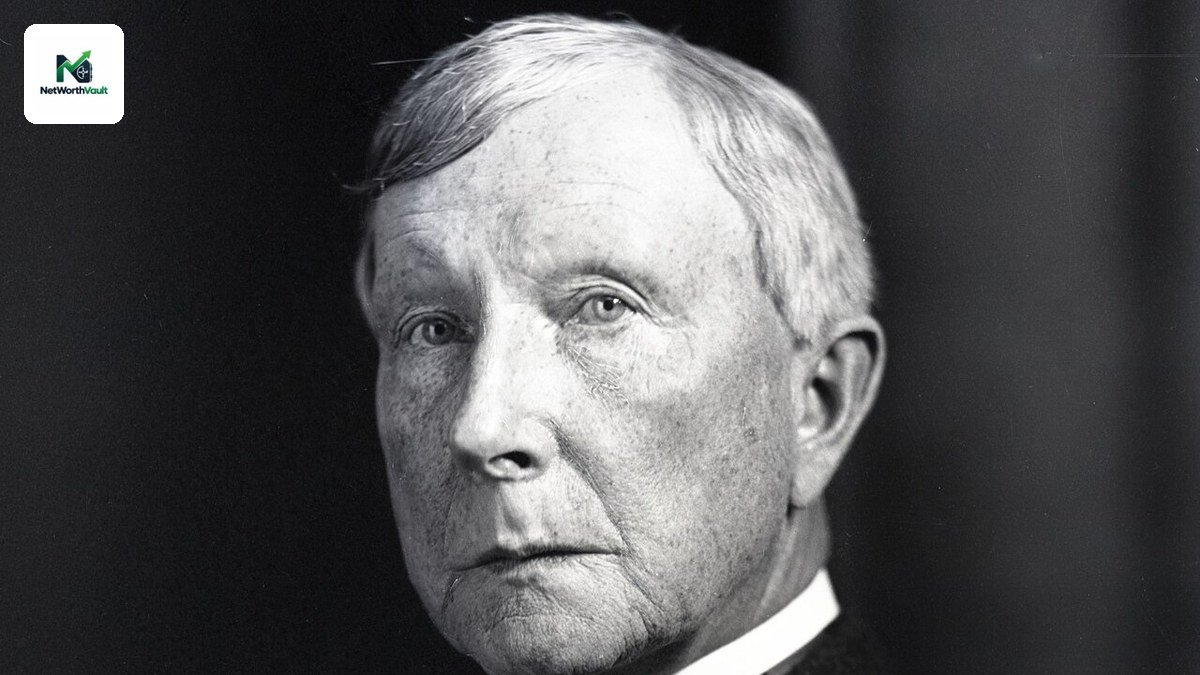
John D. Rockefeller Net Worth reached its peak in 1913, the year the next section examines in detail.
The $900 Million Peak of 1913
The year 1913 keeps coming up in every serious account of Rockefeller’s wealth, and for good reason. It was the year he founded the Rockefeller Foundation, and it was the high-water mark of his personal fortune before the great giving of his later years began to draw it down.
Why 1913? Two things had just happened. First, the Supreme Court had ordered Standard Oil broken up in 1911, and — against every expectation — the breakup had made Rockefeller richer, not poorer. The shares of the thirty-four successor companies soared in value, and Rockefeller, who kept large stakes in all of them, saw his net worth nearly triple between 1911 and 1913.
Second, the American economy was booming on the eve of the First World War, and demand for kerosene and then gasoline was climbing fast. Oil was no longer just lamp fuel. It was becoming the fuel of cars, trucks, ships, and industry.
The $900 million figure for 1913 comes from estimates published at the time and repeated by Wikipedia and other reference works. Forbes, in a separate calculation cited by Wikipedia, put the same fortune at $392 billion in 2016 dollars. Guinness World Records, using its economic-share method, puts it at $631 billion in 2024 dollars. The methods differ, but they all point to the same conclusion: in relative terms, nobody in modern history has been richer.
In that same year, he created the Rockefeller Foundation “to promote the well-being of mankind throughout the world,” and he would eventually give it $182 million, according to Wikipedia — though some other sources put his total gifts to the Foundation higher, closer to $250 million. The peak of his wealth and the peak of his giving arrived together.
How Standard Oil Built the Fortune
Rockefeller did not discover oil. He did not drill the first well. What he understood, earlier and more clearly than anyone else, was that the money was not in finding oil. It was in refining it, moving it, and selling it — efficiently, relentlessly, and at a scale nobody else could match.
He entered the oil refining business in Cleveland in the 1860s, and in 1870 he co-founded the Standard Oil Company with his brother William, Henry Flagler, Jabez A. Bostwick, Samuel Andrews, and a silent partner, Stephen V. Harkness. Within a decade it was something else entirely.
Rockefeller obsessed over costs other refiners ignored. He bought his own barrels, his own tank cars, his own pipelines. He negotiated secret rebates from the railroads that shipped his oil — discounts that let him undercut competitors who were paying full freight. He bought out rivals, sometimes at generous prices, sometimes after squeezing them until they had no choice. He reinvested profits instead of paying them out.
By the 1880s, Standard Oil refined about 90 percent of the oil in the United States. By 1900, it controlled about 90 percent of the nation’s oil production. When you refine nine out of every ten barrels of oil in the country, and you also control much of the transport and distribution, you set the price. Kerosene lit American homes. Then gasoline powered American cars. Demand kept rising, and Standard Oil was there at every stage to take its cut.
The fortune was controversial from the start. Ida Tarbell, whose father had been ruined as an independent oil producer, published her famous History of the Standard Oil Company in 1904, documenting the rebates, the secret deals, and the strong-arm tactics. Her work helped turn public opinion against the company and fed directly into the antitrust case that would break it up.
Rockefeller’s defenders said he brought order, efficiency, and cheap oil to ordinary people — and kerosene did get cheaper under Standard Oil. His critics said he did it by crushing anyone who stood in his way. Both things were true, and that tension runs through his whole story.
Parallels with modern platform monopolies are hard to miss — a point that comes up often in profiles of today’s richest founders, including the Taylor Swift net worth story, where scale and control of distribution matter just as much as talent. Rockefeller simply did it first, and on a scale never matched in relative terms.
The 1911 Breakup That Made Him Richer
On paper, 1911 should have been the worst year of Rockefeller’s business life. The U.S. Supreme Court ruled that Standard Oil was an illegal monopoly under the Sherman Antitrust Act and ordered it dismantled. The great trust was split into thirty-four separate companies. In practice, it was one of the best things that ever happened to his bank balance.
Rockefeller and the other major shareholders received shares in each of the new companies — the “Baby Oils” that would grow up to become Exxon, Mobil, Chevron, Amoco, and others. The market, freed from the fear of a single lumbering monopoly, valued the pieces more highly than it had valued the whole. The shares soared, and between 1911 and 1913 Rockefeller’s net worth nearly tripled.
It is one of the great ironies in business history: the government broke up his monopoly to curb his power, and the breakup made him the richest man who had ever lived, at least in proportional terms. He was 72 years old, long retired from running the company, and his fortune was growing faster than ever — not because he was doing anything new, but because the market finally priced his assets the way he always had.
The breakup also reshaped American business law. The Sherman Antitrust Act, passed in 1890, had been on the books for two decades, but the Standard Oil case was the one that proved the government would actually use it against the biggest company in the country. Every antitrust case since — from AT&T to Microsoft to the tech giants of today — traces part of its lineage back to that 1911 decision.
John D. Rockefeller Net Worth nearly tripled between 1911 and 1913, which is why the breakup is remembered as the making of his fortune.
John D. Rockefeller Net Worth passed $1 billion in 1916, making him America’s first billionaire, as the next section explains.
America’s First Billionaire
Rockefeller became the country’s first billionaire on 28 September 1916, according to the date most often cited by reference works including Wikipedia. The milestone is worth pausing on, because “billionaire” meant something very different then than it does now. In 1916, there was no Forbes list. There were no billionaires at all — Rockefeller was the first.
A billion dollars in 1916 was roughly 2 percent of the entire American economy. Today, there are hundreds of billionaires in the United States alone, and the richest among them hold something like 1 percent of GDP at most, and usually far less.
The New York Times obituary estimated he had accumulated close to $1.5 billion over his career from Standard Oil and his other investments. That figure — $1.5 billion earned, $1.4 billion left at death after giving away more than $500 million — gives a sense of the sheer throughput of the fortune. He made a billion and a half, gave away half a billion, and still died a billionaire.
His wealth was not just Standard Oil stock. By the time he retired, he had significant interests in banking, shipping, mining, railroads, and other industries. Standard Oil was the engine, but the fortune had diversified well beyond oil by the early twentieth century. That diversification is part of why it survived the breakup, the First World War, and the Great Depression without collapsing.
For comparison, modern readers sometimes ask how Rockefeller stacks up against founders profiled elsewhere on this site — entrepreneurs whose wealth comes from media, sports, or entertainment rather than heavy industry. The Logan Paul net worth story, for example, shows a very different kind of fortune: fast, fame-driven, and built on attention. Rockefeller’s was the opposite — slow, industrial, and built on control of a physical commodity the whole country needed.
Early Life: From a Farm in Richford to Cleveland
John Davison Rockefeller was born on 8 July 1839 on a farm in Richford, in Tioga County, New York. He was the second of six children of William Avery Rockefeller and Eliza Davison Rockefeller. The family was modest, and his father — a travelling salesman who was often away — was not a steady presence. His mother, a devout Baptist, ran the household with strict discipline and taught her children to save, to work, and to give to the church.
The family moved to Cleveland, Ohio, in 1855, when John was sixteen. Cleveland was a booming lake port, full of opportunity for a bright, disciplined young man who was good with numbers. Rockefeller left school at sixteen, took a short business course, and got his first job as a bookkeeper’s assistant at a produce commission firm, Hewitt and Tuttle, for $25 a month. He later said he celebrated the day he got that job as the start of his business life, and he kept meticulous records of every dollar he earned and spent from that day on.
From his very first paycheck, he tithed 10 percent of his earnings to his church — a habit he kept for the rest of his life, and one that grew into the largest philanthropy the world had ever seen. It is easy to forget, when looking at the billions, that the giving started when the amounts were tiny: a few dollars a month from a teenage bookkeeper who believed, quite literally, that the money was not entirely his.
He married Laura Celestia Spelman in 1864. She was the daughter of a Cleveland businessman, a former teacher, from an abolitionist family. She was, by every account, his closest adviser for the whole of their marriage. They had five children: Elizabeth, Alice (who died in infancy), Alta, Edith, and John D. Rockefeller Jr., his only son and eventual heir. Laura died in 1915, after fifty-one years of marriage.
Rockefeller lived another twenty-two years as a widower. His early business ventures were not in oil at all. He started as a commission merchant, buying and selling produce, and he did well at it. He entered the oil business in 1863, when Cleveland was becoming a refining centre for crude from the Pennsylvania oil fields, and he never really looked back.
How Much Did Rockefeller Give Away?
The short answer is: an astonishing amount, and historians still disagree on the exact total because he gave through so many channels over so many decades. Wikipedia puts the total at about $530 million. The Rockefeller Archive Center, drawing on the family’s own records, puts it at $540 million. Other sources round it to about $550 million. The differences come from what you count — direct gifts, foundation endowments, church donations, and gifts made through his son all blur together over forty years.
What is not in dispute is the scale. Half a billion dollars, given away in the late nineteenth and early twentieth centuries, was an unprecedented act of philanthropy. No one had ever given away that much money before, and it would be decades before anyone else came close.
He gave $80 million to the University of Chicago, according to Wikipedia — about $2.54 billion in 2025 dollars by that source’s calculation. He gave $182 million to the Rockefeller Foundation, which he created in 1913. He funded the Rockefeller Institute for Medical Research (founded 1901, now Rockefeller University), the General Education Board (founded 1902), and the Rockefeller Sanitary Commission (founded 1909, to eradicate hookworm in the American South).
He also gave to causes that do not fit neatly into a foundation’s annual report. In 1884, he provided major funding for a college in Atlanta for Black women that became Spelman College, named for his wife’s family. He funded medical research that helped fight yellow fever and hookworm, diseases that had plagued the American South for generations. The giving was not random.
Rockefeller hired Frederick T. Gates, a Baptist minister turned business adviser, to manage his philanthropy with the same rigour he had applied to oil. Gates insisted on careful study, measurable results, and institutions that could outlive their founder. That is why the Rockefeller Foundation, the University of Chicago, and Rockefeller University are still major forces more than a century later.
There is a genuine debate about motive, and it is worth acknowledging. Was the giving an act of faith, a sense of duty, a way to atone for the methods that built the fortune, or a calculated effort to repair a reputation battered by Ida Tarbell and the antitrust case? Probably all of them, in different proportions at different times. What matters for the net worth story is simpler: he gave away roughly a third of everything he ever made, and he still died with $1.4 billion. The fortune was that large.
John D. Rockefeller Net Worth was reduced by roughly a third through his giving, yet he still died with $1.4 billion.
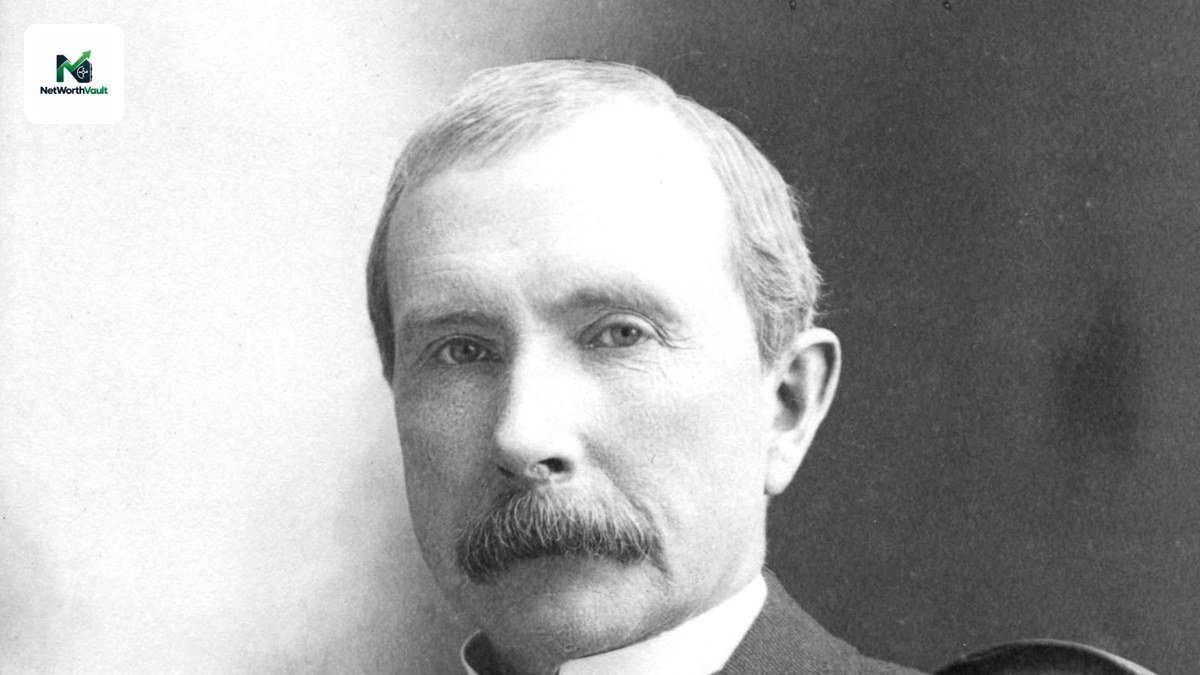
The Rockefeller Foundation and the University of Chicago
Two institutions deserve a closer look, because they show what Rockefeller’s money actually did — and why his name is on buildings, universities, and foundations all over the world. The University of Chicago was founded in 1890, and Rockefeller often called it the best investment he ever made. The American Baptist Education Society had resolved in 1889 to establish a well-equipped college in Chicago. At the urging of Frederick T. Gates, Rockefeller offered $600,000 of the first $1 million for endowment, provided the remaining $400,000 was pledged by others within ninety days. It was a classic Rockefeller move: a conditional gift that forced others to commit too. In 1910 he made a farewell gift of $10 million, which brought his total contributions to the university to about $35 million by that point; later gifts brought the total to about $80 million, according to Wikipedia.
The Rockefeller Foundation, created in 1913, was a different kind of institution — not a university, but a machine for giving money away systematically. Its charter was to “promote the well-being of mankind throughout the world,” and it funded public health, medical training, scientific research, and the arts across the globe. It endowed the Johns Hopkins School of Hygiene and Public Health, the first of its kind. It supported the fight against yellow fever and hookworm. It funded agricultural research that would later feed into the Green Revolution. It is still active today, more than a century after its founding.
These were not vanity projects. Rockefeller built institutions designed to last, staffed by professionals, and governed by boards rather than by family whim. That is why his philanthropic legacy has outlasted his business legacy in many ways. Standard Oil is gone, broken up in 1911. The University of Chicago and the Rockefeller Foundation are still here. It is a model that still shapes how large-scale philanthropy is done, from the Gates Foundation to the Chan Zuckerberg Initiative, whether those founders would admit the influence or not.
What Happened to the Fortune After His Death?
Rockefeller died on 23 May 1937 at his winter home, The Casements, in Ormond Beach, Florida. He was 97. His remaining fortune, estimated at $1.4 billion, was largely tied up in permanent family trusts. His only son, John D. Rockefeller Jr., became the principal manager of the estate. Junior had already been managing much of his father’s philanthropy and business affairs for years. He was a very different personality from his father: more reserved, more religious, more focused on giving than on getting.
Today, the Rockefeller family is large — more than 200 living descendants, according to Forbes — and the combined family wealth is estimated at roughly $8.5 billion to $10–15 billion, depending on the source and what you count. That sounds like a lot, and it is, but it is a tiny fraction of what John D. held alone. As one analysis put it, John D. held a slice of the national economy some 7,500 times bigger than the average share held by his descendants today. The fortune was split among children, grandchildren, and great-grandchildren, taxed, given away, and diluted across generations.
The family name, however, has not faded. Rockefeller Capital Management, the Rockefeller Foundation, Rockefeller University, and Rockefeller Center all carry it. The family’s influence in American philanthropy, finance, and public life — through figures like Nelson Rockefeller, who became governor of New York and vice president of the United States, and David Rockefeller, who ran Chase Manhattan Bank — extended well into the late twentieth century. The story of the Rockefeller fortune after 1937 is, in a sense, the story of every great fortune: it peaks with its founder, and then it spreads, thins, and becomes something else — a family, a set of institutions, a name — rather than a single bank balance.
Rockefeller vs. Today’s Billionaires
It is tempting to line Rockefeller up against Elon Musk, Jeff Bezos, or Warren Buffett and ask who is richer. The answer depends entirely on how you count. By raw dollars, today’s richest people win easily. Musk’s fortune has been reported at well over $400 billion, and briefly crossed $1 trillion in 2026 according to Celebrity Net Worth’s ranking. Rockefeller’s $1.4 billion in 1937, adjusted for simple inflation, is only about $31 billion — less than a tenth of Musk’s peak.
By share of the economy, Rockefeller wins, and it is not close. His 2.3 percent of GDP at his peak in 1913 is roughly double the share held by any modern billionaire at their peak. Musk, at his richest, has held about 1.5–1.6 percent of U.S. GDP, according to some analyses — impressive, but still below Rockefeller’s peak. No one else in modern times has come close to 2 percent.
Why the difference? Partly it is the size of the economy. The U.S. economy in 1913 was about $39 billion. Today it is roughly $30 trillion — nearly a thousand times larger. It is much harder for one person to own 2 percent of a $30 trillion economy than 2 percent of a $39 billion one. Partly it is also the nature of the wealth. Rockefeller’s fortune came from a physical commodity that everyone needed, refined and distributed through infrastructure he controlled. Modern fortunes come from software, e-commerce, electric cars, and social media — businesses that scale globally without ever owning a refinery.
There is one more difference worth noting. Rockefeller gave away about a third of his fortune during his lifetime and set up foundations that are still giving today. Modern billionaires have pledged to give away much of their wealth — the Giving Pledge, signed by Buffett, Gates, and others, commits them to giving away at least half — but most of that giving is still in the future. Rockefeller did his giving while he was alive, over forty years, and he built the institutions to do it properly. In that respect, too, he set the template. For a different angle on how modern fortunes are built — in entertainment rather than industry — the Ben Meiselas net worth profile shows how a media and legal career can build significant wealth in a single generation, without ever owning a refinery or a railroad.
Frequently Asked Questions
What was John D. Rockefeller’s net worth when he died?
John D. Rockefeller’s remaining fortune at his death on 23 May 1937 was estimated at $1.4 billion, according to Britannica (published 30 May 2025) and Wikipedia. The figure is an estimate, not an audited total. His New York Times obituary estimated he had accumulated close to $1.5 billion over his career before giving away more than $500 million.
What is John D. Rockefeller’s net worth in today’s money?
It depends on the method. By simple CPI inflation, his $1.4 billion in 1937 is about $31.3 billion in 2025 dollars (Britannica, 2025). By share of the U.S. economy, it is about $462 billion in 2025 dollars (Britannica, 2025). His peak fortune of $900 million in 1913 translates to $631 billion in 2024 dollars by Guinness World Records’ economic-share method (published 23 October 2024), or about $28 billion by CPI alone. Celebrity Net Worth lists him at $630 billion inflation-adjusted. There is no single correct number; the range reflects different ways of comparing money across a century.
Was John D. Rockefeller the richest person in history?
By share of the national economy, he is widely considered the richest American who ever lived and the richest private individual in modern recorded history. Guinness World Records calls him the richest individual in history when adjusted for inflation, using its economic-share method. Some ancient rulers may have controlled more absolute wealth, but their wealth was not personal in the modern sense, so most rankings exclude them.
How did John D. Rockefeller make his money?
He made it through Standard Oil, the company he co-founded in 1870. Standard Oil dominated oil refining and distribution in the United States, controlling about 90 percent of refining by the 1880s. His fortune came from refining margins, control of transport (railroads and pipelines), and the rising demand for kerosene and then gasoline. He also diversified into banking, shipping, mining, and railroads.
Was John D. Rockefeller America’s first billionaire?
Yes. He became America’s first billionaire on 28 September 1916, according to the date most often cited by reference works including Wikipedia. At the time, a billion dollars was roughly 2 percent of the entire American economy.
How much money did John D. Rockefeller give away?
He gave away about $530 million to $540 million in his lifetime, according to Wikipedia and the Rockefeller Archive Center; some sources round the total to about $550 million. His largest gifts went to the University of Chicago (about $80 million), the Rockefeller Foundation (about $182 million, per Wikipedia), the Rockefeller Institute for Medical Research (now Rockefeller University), and the General Education Board.
What happened to Rockefeller’s fortune after he died?
Most of it passed into permanent family trusts managed by his son, John D. Rockefeller Jr. Over the following decades it was divided among a growing number of descendants — more than 200 today — and the combined family wealth is now estimated at roughly $8.5 billion to $15 billion, depending on the source. The Rockefeller Foundation, Rockefeller University, and the University of Chicago remain major institutions.
Final Thoughts
John D. Rockefeller’s net worth is not really a number. It is a story about scale — about what it meant for one man to own 2 percent of the American economy, to build the company that powered the country’s transformation, and then to give away a third of it and still die a billionaire.
The figures will keep being debated, because they should be. $1.4 billion in 1937. $900 million at the peak in 1913. $31 billion by inflation, $462 billion by GDP share, $631 billion by Guinness’s economic-share method. Each number is an estimate, each answers a different question, and each is incomplete on its own. What they add up to is a simple, stubborn fact: no American, before or since, has owned as large a slice of the country as John D. Rockefeller did.
That is worth remembering the next time a headline announces a new richest person in the world. The dollars get bigger every year, because the economy gets bigger every year. The share of the economy — the real measure of economic power — has never been matched since Rockefeller. If you want to explore more stories of extraordinary wealth, the Aishah Hasnie net worth profile offers a very different kind of fortune — built in modern broadcast journalism rather than nineteenth-century industry.
For more visual inspiration on Rockefeller’s life, legacy, and the Gilded Age, see this Pinterest search: https://www.pinterest.com/search/pins/?q=john-d-rockefeller-net-worth